Ed Sappin | Philanthropy & Community

Giving & Volunteering

  • Home
  • Philanthropy & Community Blog
  • Contact

Brooklyn Progressive: The Art of Gertrude Sappin

September 18, 2017 by Sappin

I am back after a hiatus and will continue to highlight unique and interesting artists. My next profile is of Gertrude Sappin, who was also my grandmother.

Gertrude Kellerman was born in Hungary in 1902 and emigrated to the United States in her teens. She settled in Brooklyn, New York and became a lifelong progressive. After having a family and raising them, Gertrude Sappin became a well known artist later in life. She passed away in 1992.
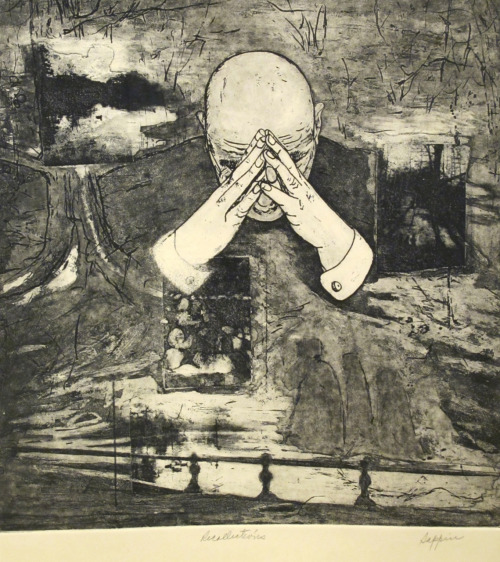
 

Gertrude Sappin Recollections


My grandmother’s art career began when she was in her 60s. A force of nature, she and her colleagues founded the Contemporary Artist’s Guild around 1968. Grandma Gertrude’s work ranged from oil paintings, to etchings, to lithographs, to sketches. My personal favorite is Recollections, with a representation of Winston Churchill at center and wartime images surrounding him.

Grandma Gertrude exhibited with CAG at the Brooklyn Musem of Art, Lincoln Center, and Lever House, amongst other venues. I fondly remember attending many of these exhibitions as a boy.

I’ve recently put together a basic website for my grandmother’s work. I hope to expand it over time.
 

Share this:

  • Twitter
  • Facebook
  • LinkedIn
  • Email
  • Reddit
  • More
  • Print
  • Pocket
  • Tumblr

Filed Under: Art, Community, Museums Tagged With: art, Brooklyn, gertrude sappin, museums, new york, sappin

Nature, Technology and Humanity through the Worlds of Robert and Shana ParkeHarrison

October 28, 2016 by Sappin

In 2007, I was living in Shanghai and decided to come back to the US for a visit to see my family in New York. I also passed through Chicago to attend the law school commencement of a cousin living there. Trudging through the winter in Chicago was actually fun (my cousin graduated midyear). I had some free time during the trip and visited the Catherine Edelman Gallery in River North, where I first saw the works of Robert and Shana ParkeHarrison.

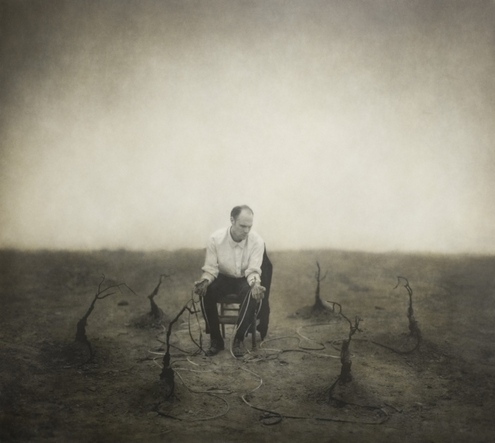
I was taken with the worlds the ParkeHarrison’s depicted in their bleak photographic works – the environment suffering greatly, often with an everyman trying to help heal some of the ills that have befallen Mother Nature.

Earth Elegies by Robert and Shana ParkeHarrison (from the artists’ website)

Earth Elegies by Robert and Shana ParkeHarrison (from the artists’ website)

The ParkeHarrisons became one of my favorites from that day onwards. Their statement is one of alarm, concern and warning of the world we live in and where it may lead:

We  create works in response to the ever-bleakening relationship linking humans, technology, and nature. These works feature an ambiguous narrative that offers insight into the dilemma posed by science and technology’s failed promise to fix our problems, provide explanations, and furnish certainty pertaining to the human condition.  Strange scenes of hybridizing forces, swarming elements, and bleeding overabundance portray Nature unleashed by technology and the human hand.  

Rich colors and surrealistic imagery merge to reveal the poetic roots of the works on display.  The use of color is intentional but abstract; proportion and space are compositional rather than natural; movement is blurred; objects and people juxtaposed as if by chance in a visual improvisation that unfolds choreographically.  At once formally arresting and immeasurably loaded with sensations—this work attempts to provide powerful impact both visually and viscerally. 

– Robert and Shana ParkeHarrison (as posted on the artists’ website)

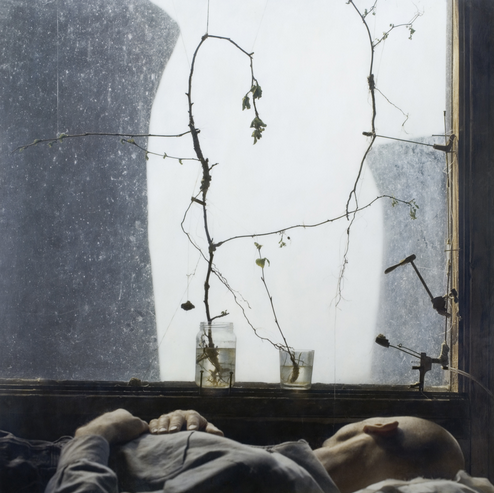
While their artistic statement expresses great concern of a potentially apocalyptic future, the ambiguity in their statement also points to the ability to correct our course and become better stewards of the land. On that day in Chicago, I was particularly taken with Gray Dawn, a dreary, contemplative work. Our everyman lays on a bed, asleep still or waking we do not know, with a dirty window in front of him and a scene outside dominated by a power plant or industrial facility. However, there are signs of life, of Mother Nature, as plant trimmings sprouting in the foreground point to another dawn.

 Gray Dawn by Robert and Shana ParkeHarrison (from the Catherine Edeleman Gallery website)


Gray Dawn by Robert and Shana ParkeHarrison (from the Catherine Edeleman Gallery website)

The ParkeHarrisons are well represented by major galleries in New York, Chicago, and Colorado and their works have been included in the permanent collections of institutions including the Whitney, the National Museum of American Art in Washington, DC and the Museum of Arts in Boston. If you have a chance to see their creations I highly recommend it.


Share this:

  • Twitter
  • Facebook
  • LinkedIn
  • Email
  • Reddit
  • More
  • Print
  • Pocket
  • Tumblr

Filed Under: Art, Edward Sappin, Museums, Photography Tagged With: art, ed sappin, humanity, museums, nature, photography, technology

The Brilliance of Michael Kenna

August 16, 2016 by Sappin

This is the first of a series profiling some of my favorite artists, living or past.

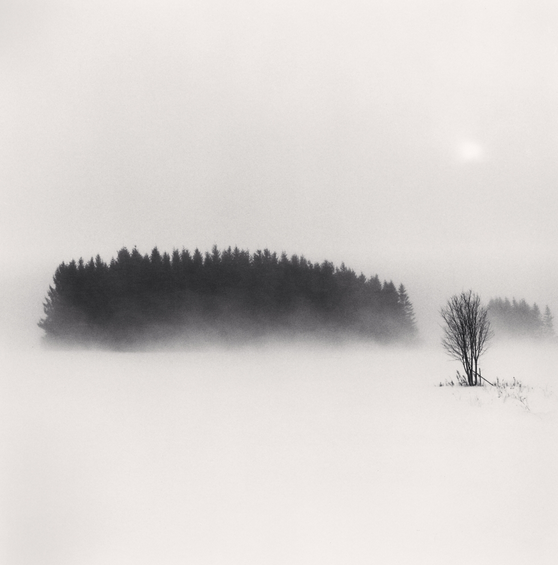
Michael Kenna is a rare modern photographer – his work is both lauded by the art world and has crossed over into the mainstream market. You can walk into some of the most rarefied galleries in the US or abroad and see his original prints, or go on to Overstock and buy a framed poster. What is the appeal?

Kenna creates ethereal, beautiful landscapes with high contrast, and small format. His works jewel boxes, taking us along for a trip to see the world around us anew.

Ed Sappin - Japanese art

Winter Sun, Kami Oumu, Hokkaido, Japan. 2004

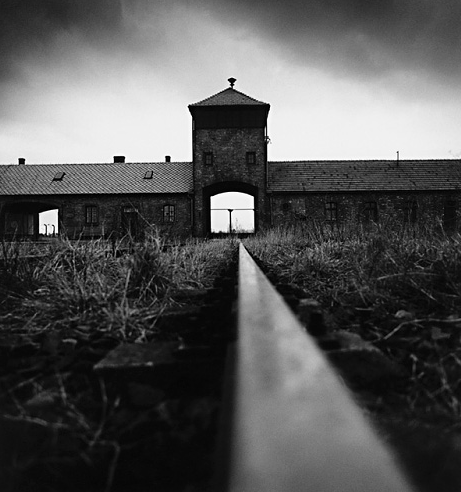
Born in Lancashire, England and currently residing in Seattle, Washington, Kenna is best known for his works of Asia, specifically Japan. He is also an accomplished commercial photographer who has worked with some of the world’s leading brands. On the more serious front, Kenna has also turned his lens to subjects including concentration camps and the changing landscape of the Middle East. His image below of the railway lines at Birkenau is haunting and beautiful, a counterpoint to the horrors that took place in this slice of the Polish countryside.

Ed Sappin -Railway Lines

Railway Lines and Entry Building, Birkenau, Poland, 1992

Kenna is represented by a who’s who of galleries around the world and is often the subject of individual and part of group exhibitions. Next time you have an opportunity to see his work in a city near you, I highly recommend it.

Share this:

  • Twitter
  • Facebook
  • LinkedIn
  • Email
  • Reddit
  • More
  • Print
  • Pocket
  • Tumblr

Filed Under: Edward Sappin, Photography Tagged With: art, black and white, contrast, ethereal, landscape, Michael Kenna, photography

Traveling Exhibits at the ICP Museum

August 4, 2016 by Sappin

The International Center for Photography, which I’ve written about before, showcases exhibitions that travel to and from venues worldwide. Because of this “traveling exhibition” feature, ICP’s exhibits are worldly and intermittent; since the photographs featured tour the world, they are viewed by people of all ages, ethnicities and nationalities. This makes it all the more impactful to get a glimpse as New York takes its turn.

At the ICP there is currently a traveling exhibition called The Mexican Suitcase, a collection gives the public a chance to experience rare images recovered from negatives from the Spanish Civil War. In 2007, three boxes of 4,500 35mm negatives considered lost since 1939 arrived at the ICP. The photographs were taken by three photographers, Robert Capa, Gerda Taro, and Chim (David Seymour.) These men — who lived in Paris and worked in Spain — laid the foundation for modern war photography.

Their coverage of the Spanish Civil War is considered uniquely innovative and passionate — The New York Times has a great review of the exhibit for those that want to know a bit more. The article describes the lives and struggles of the artists and the story the exhibit tells of their lives and works. Described are the three boxes, “timeworn but intact,” a tattered telegram, notebooks, and many images of everyday Spanish life during the war. Here’s an excerpt:

This total immersion, made possible by increasingly hand-held cameras, generated huge numbers of images. And that’s what you get in this show: hundreds and hundreds of tiny pictures lined up edge to edge on contact sheets to create a display of a kind that museumgoers rarely encounter but that photographers see all the time: squint-inducing, unedited, in progress.

Another traveling exhibit, which unfortunately ended on July 31, is Capa in Color, a glimpse at the famous photojournalist’s colored photography, most of which captured life postwar. The exhibit showcased over 100 contemporary color prints that demonstrate how Capa adapted to color photography and a new postwar sensibility.

Seeing as the traveling exhibits inherently change up, it’s worth checking in every so often to see what’s featured. Some exhibits are only briefly showcased, while others, like the Mexican Suitcase, span four months or more. If you’re a photography enthusiast like me, there’s a good chance you’ll be delighted. After all, photography is an artform that documents a singular moment. It makes sense that exhibits would be transient, too.

Share this:

  • Twitter
  • Facebook
  • LinkedIn
  • Email
  • Reddit
  • More
  • Print
  • Pocket
  • Tumblr

Filed Under: Photography Tagged With: art, ed sappin, Edward Sappin, icp, photography, the mexican suitcase, traveling exhibit

Spring is Here and the Art World is Blooming

March 28, 2016 by Sappin

It is spring in New York and the museum and art worlds are busy with events, fundraisers and auctions. My wife Yanhua and I were fortunate to take part in The Rubin Museum’s annual spring series Brainwave. Emotion is the theme this year and we had an interesting afternoon with Bob Mankoff of the New Yorker and neuroscientist Scott Weems exploring laughter. What makes people laugh and how does the brain process it?

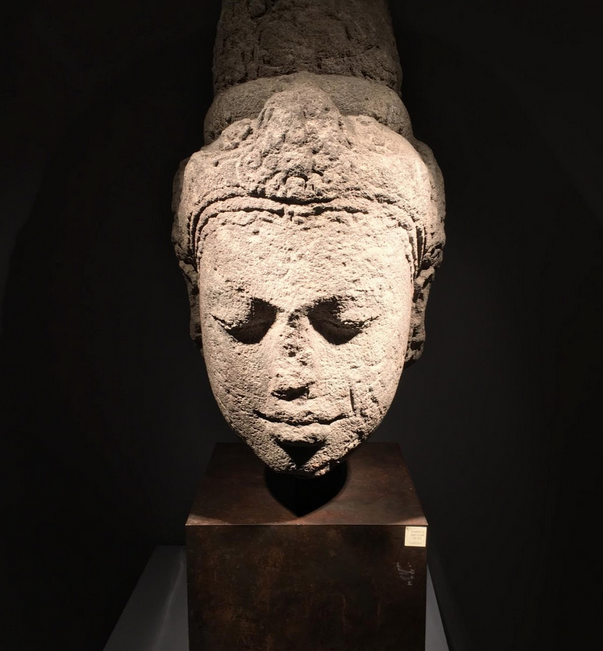
We also were able to attend several events around Asia Week New York at the Rubin and at Christie’s. The opening of the auction at Christie’s included a number of beautiful pieces. My favorite was the head of an unnamed bodhisattva from Indonesia (below),

Ed Sappin philanthropy

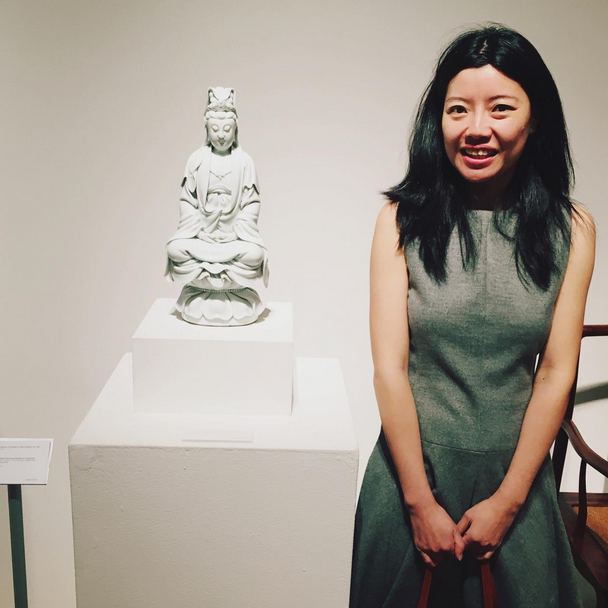
while my wife Yanhua preferred a statue of Guanyin, the Mahayana Buddhist bodhisattva. I guess we were both looking for guides on our path to enlightenment.

Ed Sappin philanthropy

I was sad to miss the Armory Show but one of my favorite events, the AIPAD show, is coming up in a few weeks. It is the pre-eminent photography show in New York and brings together some of the best galleries in the world. I am looking forward to seeing the new works from husband and wife duo Robert and Shana ParkeHarrison who are presented by the Catherine Edelman Gallery in Chicago.

On the volunteer front, I’ve been hard at work on a new civic venture to create family wage jobs for an underserved population in New York City. More to come on this in future blog posts.

Share this:

  • Twitter
  • Facebook
  • LinkedIn
  • Email
  • Reddit
  • More
  • Print
  • Pocket
  • Tumblr

Filed Under: Asia Society, Edward Sappin Tagged With: art, Asia, museum, Philanthropy, Rubin Museum, spring

Recent Posts

  • 10 New York Charities to Consider during the Holidays
  • Brooklyn Progressive: The Art of Gertrude Sappin
  • Running with and for the Community
  • The Giving Season
  • Forever Paris: Willy Ronis’s Striking Style
  • Facebook
  • Instagram
  • Linkedin
  • Twitter
  • Vimeo

Links

  • Community and Business Leader
  • Ideas & Innovation
  • Instagram
  • Sappin Global Strategies
  • Sappin Photography

return to top of page

Copyright © Edward Sappin · 2026